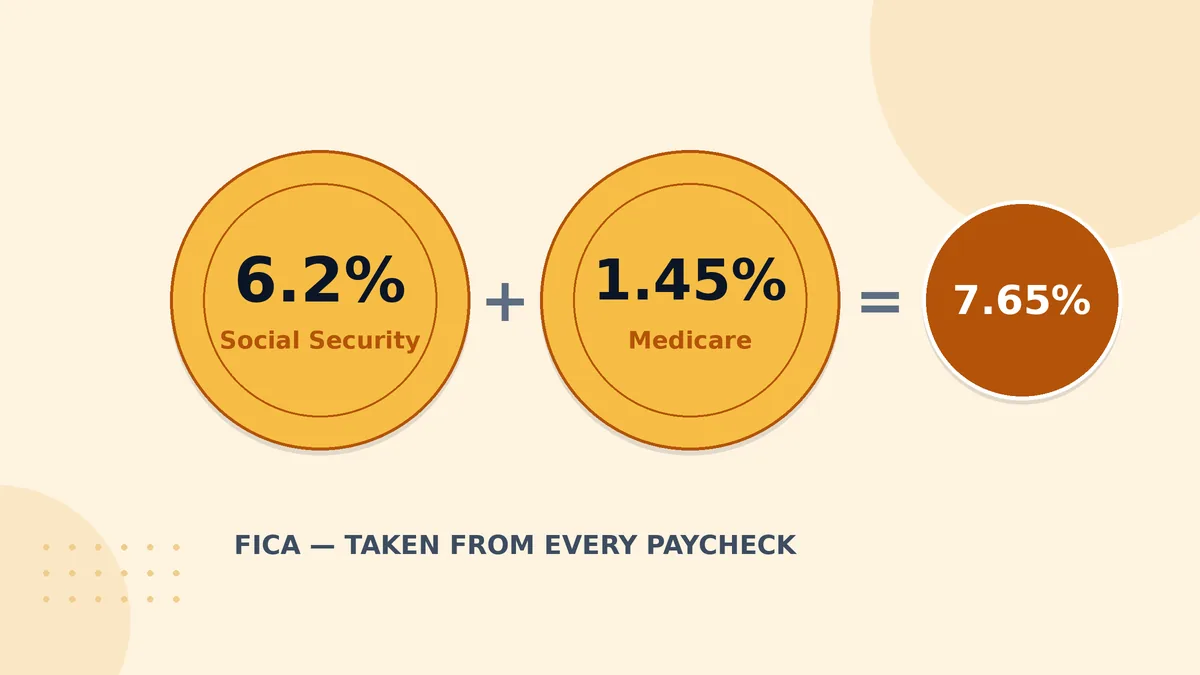
What Is FICA? The 7.65% on Every Paycheck
FICA is the payroll tax that takes 7.65% out of almost every paycheck in America — whether you owe income tax or not. It is not an employer fee, and it is not optional. Federal law requires it on wages from the first dollar, split between Social Security and Medicare, the two programs it funds. Here are the rates, the cap, and the match you never see.
What FICA stands for — and what it funds
FICA stands for the Federal Insurance Contributions Act, the law behind this deduction. Your dollars go into the Social Security and Medicare trust funds, which pay current retirees, disabled workers, surviving family members, and people on Medicare — not general spending like roads or defense. Withholding today largely funds benefits paid today, while your taxed work builds your own eligibility for later. That is why FICA sits on your stub as its own line — SS, OASDI, Medicare, or FICA — apart from income tax.
The two parts of FICA
Social Security: 6.2% up to a wage cap
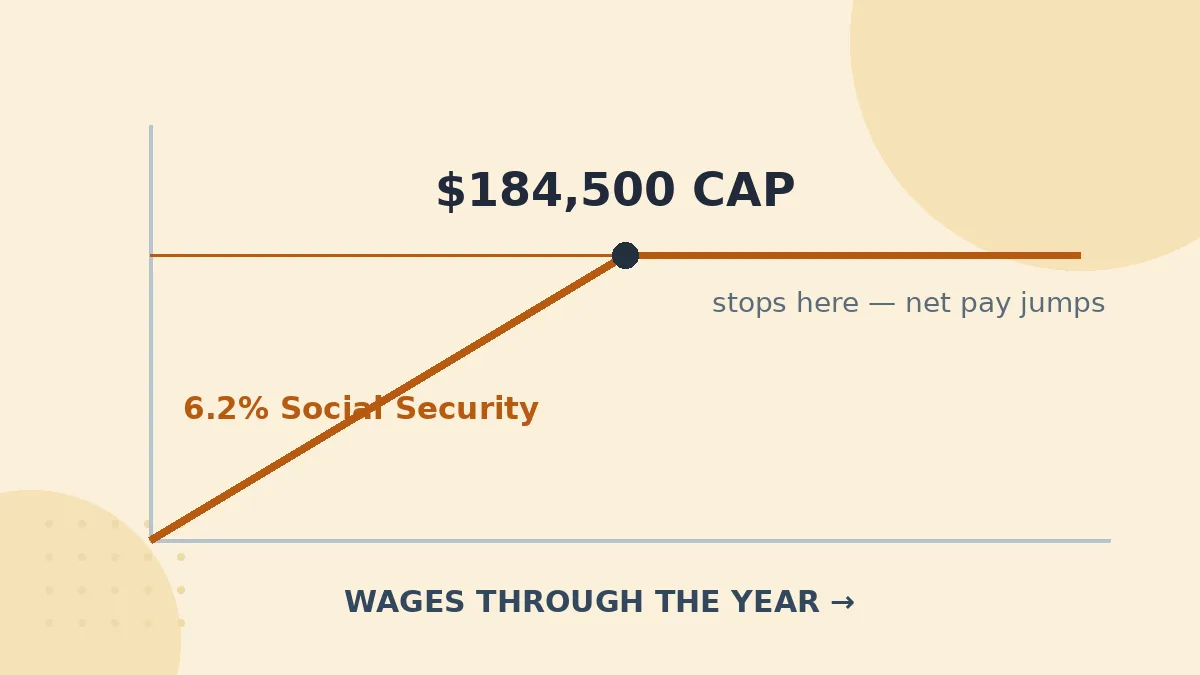
You pay 6.2% toward Social Security, but only on wages up to an annual cap — $184,500 in 2026, called the wage base. Past that line, withholding stops for the year and further wages escape Social Security tax entirely. Bonuses, overtime, and commissions count as wages, so a big bonus can push you over sooner.
Medicare: 1.45% on every dollar, plus 0.9% at the top
You also pay 1.45% toward Medicare on every dollar of wages, with no cap. Higher earners owe an extra 0.9% Additional Medicare Tax. Your employer must begin withholding that 0.9% once your wages from that employer pass $200,000 in a year. At filing, the tax applies above $200,000 single and $250,000 married filing jointly, so married households may owe a little more or get a little back — a rare FICA amount reconciled on a return.
Worked example: a $60,000 salary
On a $60,000 salary paid biweekly over 26 checks: Social Security is $60,000 × 6.2% = $3,720.00 a year, and Medicare is $60,000 × 1.45% = $870.00, for total employee FICA of $4,590.00. Per check: $143.08 Social Security and $33.46 Medicare — $176.54 total, before income tax. Stub numbers near these mean your FICA is correct.
Worked example: a $250,000 salary
On a $250,000 salary (single filer), Social Security is capped: $184,500 × 6.2% = $11,439.00. Medicare is not capped: $250,000 × 1.45% = $3,625.00. Wages also pass $200,000, so Additional Medicare Tax is withheld on the extra $50,000: $50,000 × 0.9% = $450.00. Total employee FICA is $15,514.00 for the year. Above the cap, your effective FICA rate falls.
The employer match you never see
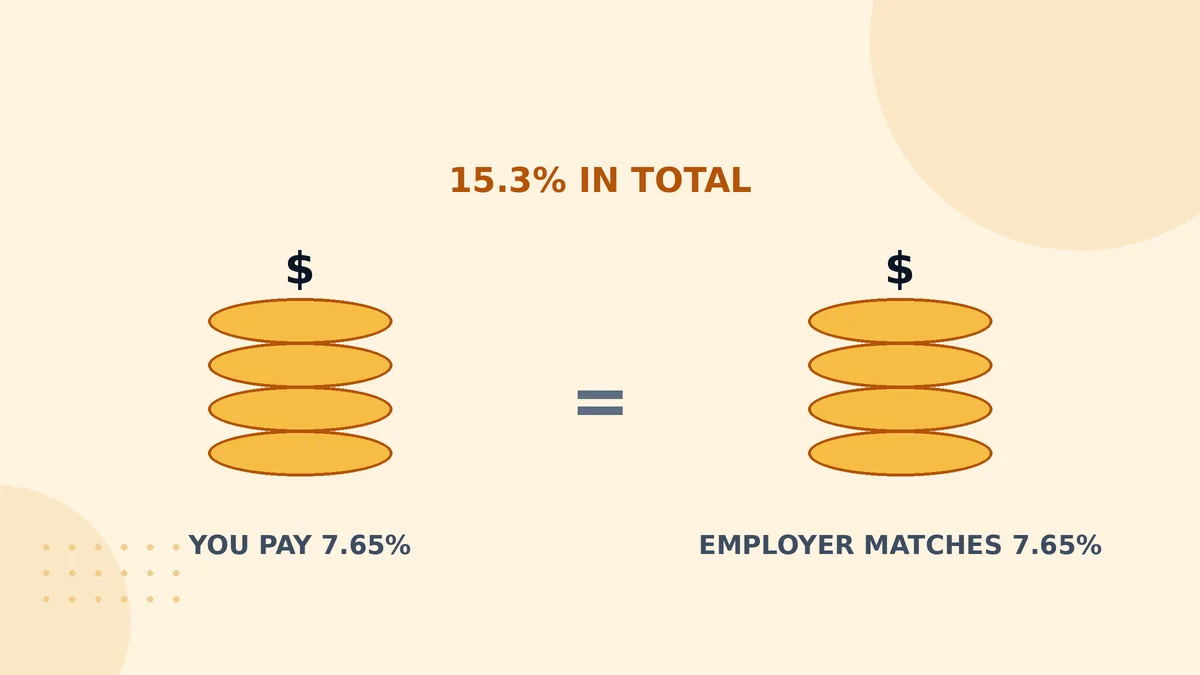
Your employer pays the same 7.65% on top of your wages — 6.2% for Social Security up to the cap, 1.45% for Medicare — so 15.3% in total reaches the two programs. You never see the employer half deducted because it was never part of your gross pay. Employers do not match the extra 0.9% surtax; you pay that alone.
If you are self-employed, you pay both halves
With no employer to split the cost, freelancers and sole proprietors pay both halves as self-employment tax — 15.3%, under the same cap and rules. It is figured on net earnings and paid via estimated taxes and the annual return. It looks steep only because you see the employer half employees never see.
What the money buys
Social Security pays retirement benefits based on your taxed work history, disability benefits if a qualifying disability stops you working, and survivors benefits for eligible family members. Medicare provides health insurance, most commonly from age 65. FICA does not sit in a personal account in your name — but without taxed wages on your record, you build no eligibility, so check your Social Security earnings record to confirm every year counted.
The cap in action — and the two-job quirk
Cross $184,500 in, say, October, and the 6.2% line disappears from your next check; net pay jumps, sometimes by hundreds. Nothing is broken. It restarts in full every January 1 — why a January check can look smaller than December's on the same salary.
Two jobs create a quirk few people know: each employer applies the cap alone, so together they can withhold Social Security tax on more than $184,500. That excess is not lost — claim it back as a credit on your return. Medicare differs: each employer withheld its 1.45% correctly, so that share is never refunded.
FICA vs. federal income tax
FICA is a flat percentage from the first dollar, with almost no deductions or credits, and it is final as withheld. Income tax is graduated, depends on filing status, deductions, and credits, and is only estimated during the year — hence the refund or bill at filing. You can owe zero income tax and still have paid thousands in FICA.
Common mistakes
Expecting a FICA refund. A tax refund does not include FICA back. Apart from the two cases above, correctly withheld FICA stays withheld.
Thinking all of FICA stops at the cap. Only the 6.2% Social Security part stops. The 1.45% Medicare part — and the 0.9% surtax, if it applies — continues on every remaining dollar.
Believing you can opt out. For nearly all workers, you cannot. FICA is a condition of covered employment, not a plan you join; an employer who skips it faces penalties.
Confusing FICA with income tax. Check the lines separately. A correct FICA line can sit beside an income-tax line that needs a W-4 fix — and changing your W-4 does not change FICA at all.
Frequently asked questions
Is FICA a tax?
Yes — a mandatory federal payroll tax, collected with the same force as income tax. It simply funds two specific programs at its own rates.
Why did my FICA change mid-year?
Usually the cap: past $184,500 the 6.2% line stops and net pay rises. A raise, bonus, second job, or crossing $200,000 into the 0.9% surtax can also change it.
Is anyone exempt from FICA?
Exemptions are narrow: students working for the school they attend can qualify for the student exception, and certain nonresident visa holders — some F-1 and J-1 holders, for example — may be exempt for a limited period. Nearly everyone else pays in full. Confirm with payroll before assuming a missing line is correct.
What happens to FICA if I have two jobs?
Each employer withholds as if it were your only job, so combined wages can over-withhold Social Security tax past the cap; recover the excess on your return. Medicare from each job is correct and not refunded.
See your own FICA lines: Paycheck Calculator →