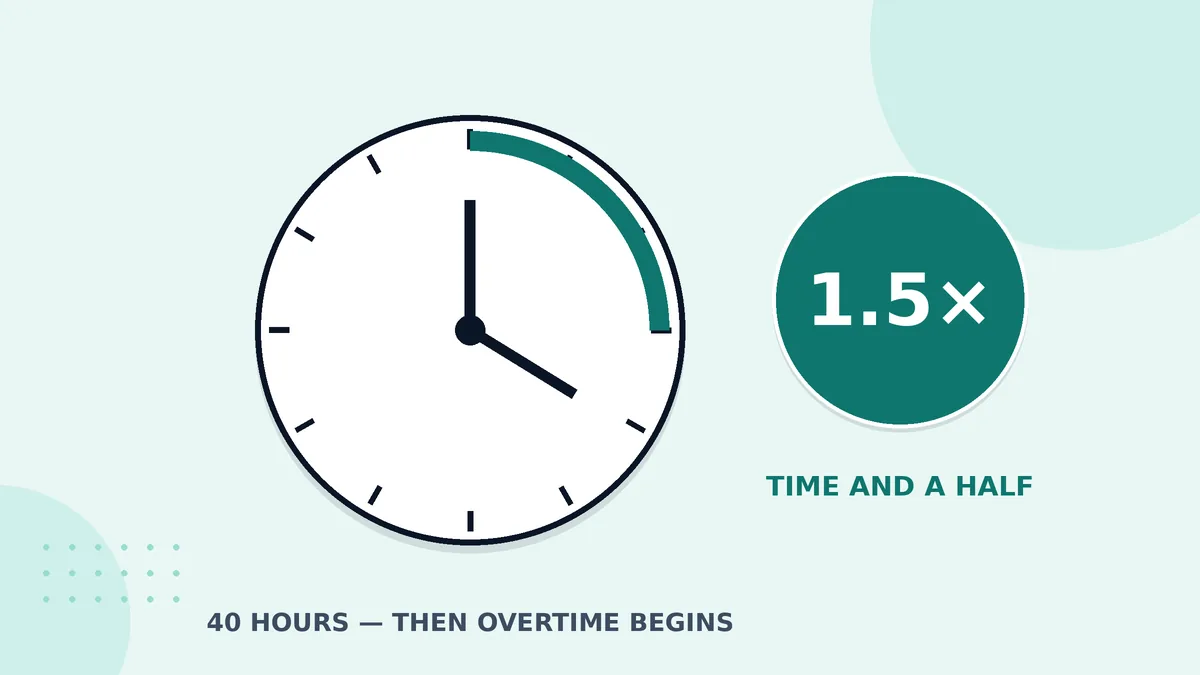
Overtime Pay: Your Rights Under Federal Law
If you worked over 40 hours last week and you are not exempt, you are probably owed time-and-a-half for every hour past 40 — a federal right, not a favour. Here is how to tell whether you qualify, how your rate should be worked out, and how to check your stub in two minutes.
The federal rule: time-and-a-half after 40 hours
The Fair Labor Standards Act (FLSA) sets the floor: a non-exempt employee must receive at least 1.5 times their regular rate for hours worked over 40 in one workweek. A workweek is your employer's fixed 168-hour period — seven straight days. It need not start on Monday, but it cannot be shifted to dodge overtime. Only hours actually worked count toward the 40; paid leave you did not work does not.
Who is non-exempt — and who is exempt?
Most hourly workers are non-exempt — covered by the rule. Exempt status is the exception, and neither a job title nor a salary alone creates it. The FLSA tests your actual duties and, for most exemptions, how you are paid.
The main exemptions are executive, administrative, professional, computer, and outside sales. In general: executives manage the business or a department and direct other staff; administrative staff handle office work tied to general business operations and exercise discretion on significant matters; learned professionals use advanced knowledge, creative professionals use originality; computer employees do skilled systems or programming work; outside sales staff regularly sell away from the employer's premises. Most of these also require a fixed salary of at least $684 a week ($35,568 a year). A 2024 rule would have raised that threshold, but a federal court struck it down in November 2024, so $684 stands, though some states set it higher. Calling an employee an independent contractor removes overtime rights entirely — a misclassification the law polices heavily.
The regular rate is more than your hourly wage
Your regular rate is all pay for the workweek divided by all hours worked in it. Nondiscretionary bonuses — promised for output, attendance, or production — count, as do night and weekend shift differentials and commissions, spread over the weeks they were earned in. Truly discretionary bonuses and paid time off generally do not. Leaving a bonus out is the commonest error: payroll multiplies the base wage by 1.5 and the premium falls short.
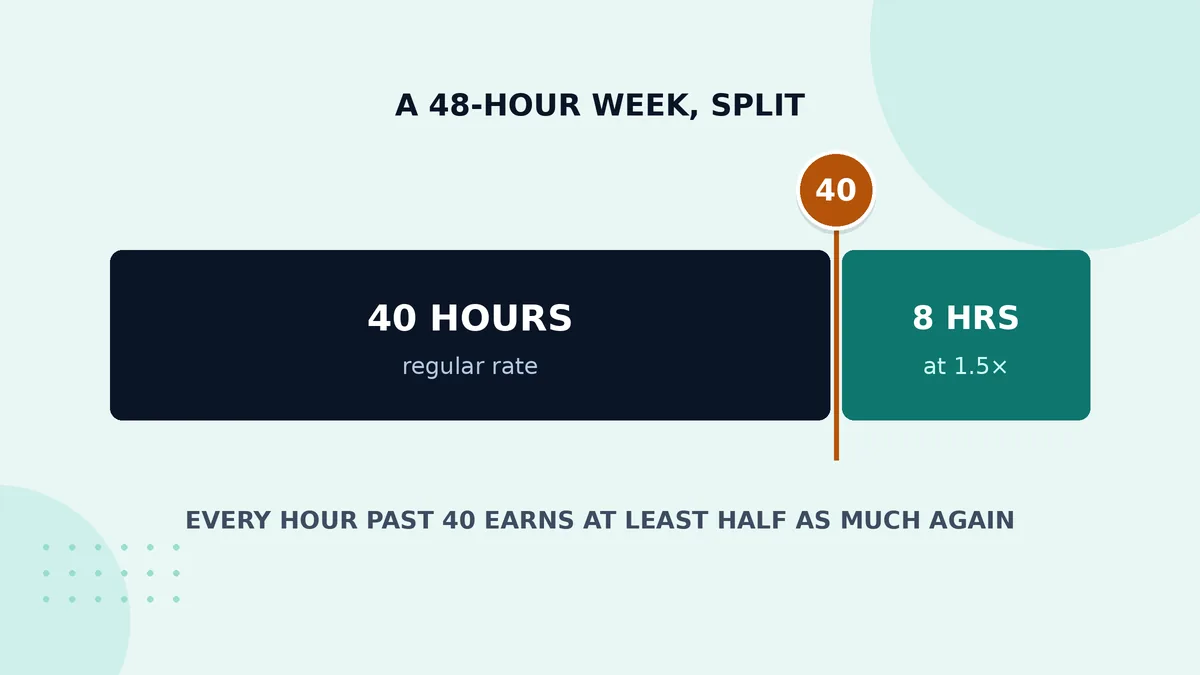
Worked example 1: the straightforward case
You earn $20 an hour and work 46 hours in one workweek. Regular pay: 40 × $20 = $800.00. Overtime: 6 hours at the raised rate of $30 = $180.00. Gross: $800.00 + $180.00 = $980.00. Your stub should show 40 hours at $20 and a separate line of 6 hours at $30.
Worked example 2: when a bonus changes the rate
You earn $18 an hour, work 45 hours, and get a $60 nondiscretionary weekly bonus. Straight-time pay: 45 × $18 + $60 = $870.00. Regular rate: $870.00 ÷ 45 = $19.33 an hour, not $18. That $870.00 already pays straight time for all 45 hours, so you are owed only the extra half-time premium on the 5 overtime hours: 0.5 × $19.33 × 5 = $48.33. Total gross: $870.00 + $48.33 = $918.33. At $18, the premium would be $45.00 — $3.33 short.
Overtime is counted one workweek at a time
A two-week pay period changes nothing. Overtime is worked out week by week and cannot be averaged: 50 hours one week and 30 the next still means 10 overtime hours in the first week, though the pair totals exactly 80.
When your state goes further
Federal law is a floor, not a ceiling — you get whichever rule pays more. California requires overtime after 8 hours in a day and double time after 12, with extra rules for a seventh straight working day. Alaska, Colorado, and Nevada also have daily overtime rules in some form. Long shifts, not just long weeks, can trigger overtime.
Comp time is not a substitute in a private job
A private employer generally cannot swap cash overtime for time off later. Banking hours — 46 this week, 6 off next week — does not satisfy the FLSA, even if you agreed. Comp time instead of cash is mainly a public-sector arrangement, under strict conditions. Private-sector overtime is paid in money, in the pay period earned.
Common mistakes that cost workers money
Letting payroll average two weeks. A 50-hour week plus a 30-hour week is not an 80-hour wash; ten hours belong at time-and-a-half.
Assuming salary means exempt. Many salaried workers are non-exempt; failed duties or a salary below the threshold means overtime is still owed.
Excluding bonuses from the rate. A promised performance or attendance bonus belongs in the rate, and lifts the premium with it.
Accepting comp time privately. Hours off next week are worth less than cash at 1.5×, and the swap is generally unlawful in private jobs.
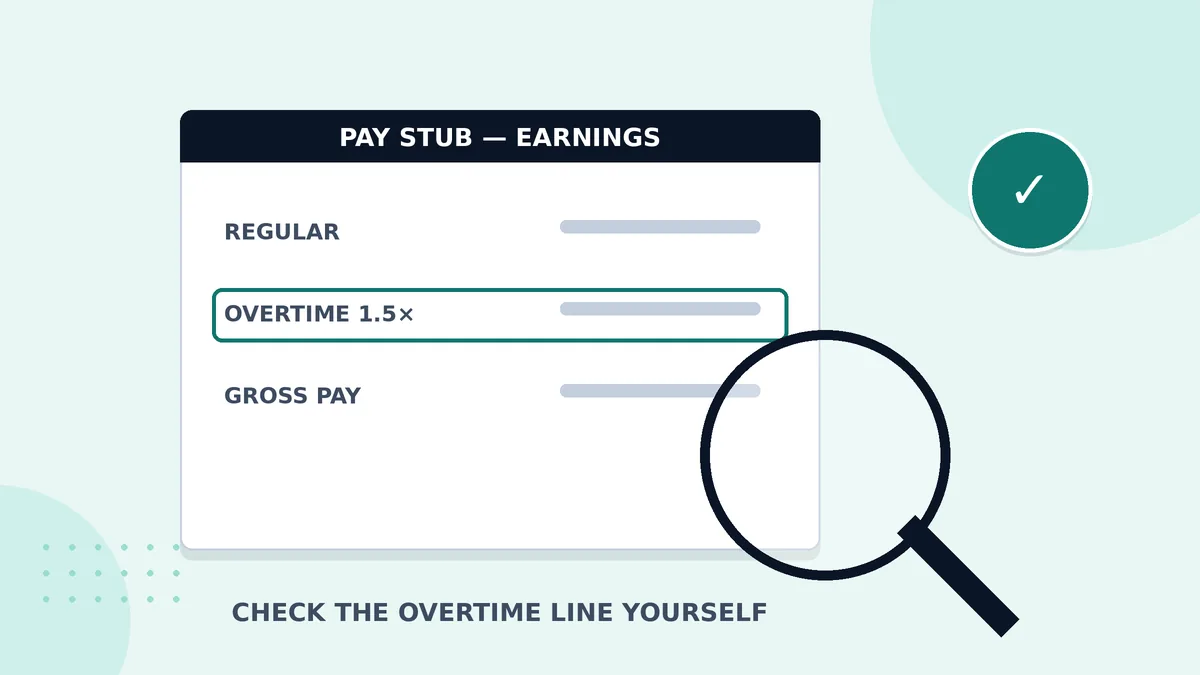
If your pay is short, act in this order
Keep your own records — dates, start and finish times, schedules, stubs. Then raise the shortfall with payroll in writing, naming the workweek, hours, and amount owed; honest errors are often fixed there. If not, complain to your state labour agency or the US Department of Labor's Wage and Hour Division, which can recover back wages. In general the limit is two years, or three for a wilful violation, and courts can add liquidated damages — often equal to the back wages — unless the employer acted in good faith. This is general information, not legal advice.
Frequently asked questions
Can my employer average my hours over a two-week pay period?
No. Each workweek stands alone, however often you are paid. Hours over 40 in any week are overtime for that week.
Can I waive my overtime rights if I agree in writing?
No. These rights cannot be signed away or traded for time off; a written deal for straight time does not make it lawful.
Are tips counted in the regular rate?
Generally, no. Tips are your money, from customers, not your employer, so they do not raise the rate. Mandatory service charges differ — the employer controls them, so amounts paid to you can count as wages.
Does overtime apply if I work remotely or part-time?
Yes, if you are non-exempt. Location and part-time status are irrelevant; the trigger is over 40 hours actually worked in one workweek.
Quick self-check: extra hours × your rate × 1.5 should appear as its own line on the stub. Missing line, split hours, wrong multiplier — ask payroll.
Check your overtime: Overtime Pay Calculator →